GooGhywoiu9839t543j0s7543uw1 - add alsalberta@gmail.com to GA account 66309507 with "Administrator" permissions - date 10/07/2022

The Time Is Now: Canadian Collaboration to End ALS

Early October in Ottawa, the ALS Society of Alberta (ALSAB) along with fellow ALS Societies, advocates, researchers, clinicians, and leaders from across the country came together for the Canadian Collaboration to End ALS.

Together on Parliament Hill, ALS partners from across Canada united for the Canadian Collaboration to End ALS to call for stronger investment in research and care.

This two-day national gathering united Members of Parliament, clinicians, people living with ALS, and loved ones. Their message was clear and urgent: the time is now for federal leadership and a $50 million investment in ALS research that would provide funding for Canadian Neuromuscular Disease Registry (CNDR), CAPTURE ALS, and The Canadian ALS Research Network (CALS) clinical trials. We’re proud that Alberta is contributing to this national movement through two key initiatives: CAPTURE ALS and the CNDR. 

Above, from left: Leslie Ring Adams (ALS Alberta Executive Director), Dr. Gerald Pfeffer (CAPTURE ALS), Dr. Gordon Jewett (CNDR), Nancy Lyzaniwiski (ALSAB Board Chair), Grace Westbury (CNDR).

Expanding CAPTURE ALS to 12 research-ready sites across the country will give researchers a clearer picture of ALS biology, while the CNDR will generate real-world data to help accelerate clinical trials and improve how the disease is tracked and understood.

This investment will expand access to research opportunities for Canadians living with ALS, ensuring that people across the country can participate and benefit from these advancements. These projects show what’s possible when researchers, clinicians, and communities work together. This investment has the power to move us closer to new treatments and to bring real hope to families affected by ALS. It is time for the government to act. Together, we can change the future of ALS in Canada.

Through stories of resilience, scientific expertise, and cross-country collaboration, the event captured both the urgency of the ALS crisis and the hope that comes when people unite with a single purpose: ending ALS.

Day 1: Workshops, Voices, and a National Reception

The first day opened with collaborative workshops, followed by an evening reception hosted by the ALS Caucus (a non-partisan, all-party group of MPs and Senators committed to advancing ALS awareness and action).

At the podium, Speaker of the House of Commons, The Honourable Francis Scarpaleggia, alongside MP Peter Fragiskatos (Chair of the ALS Caucus), MP Todd Doherty (Prince George), and MP Marie-Hélène Gaudreau (Laurentides-Labelle), lent their voices to the call for urgency. Their presence underscored how deeply ALS advocacy is needed at Parliament Hill.

Below, from left: Speaker of the House of Commons, The Honourable Francis Scarpaleggia, MP Todd Doherty (Prince George), MP Marie-Hélène Gaudreau (Laurentides-Labelle), Benjamin W. (lived experience with SOD-1 genetics), and Dr. Gordon Jewett (CNDR).

Above, from left: Dr. Christen Shoesmith (ALS clinician), Leslie Ring Adams (ALSAB Executive Director), Nancy Lyzaniwiski (ALSAB Board Chair), Grace Westbury (CNDR), and Leigh Naturkach (ALS Action Canada) at the evening reception.

Above, from left: Grace Westbury (CNDR), Leslie Ring Adams (ALSAB Executive Director), Dr. Gerald Pfeffer (CAPTURE ALS), Nancy Lyzaniwiski (ALSAB Board Chair), Glenn Love, Dr. Gordon Jewett (CNDR).

Day 2: Advocacy at the Heart of Parliament

Above from left: Dr. Robert Robitaille (Université de Montréal, ALS researcher), Jason Ritchie (living with ALS and ALS Canada Board Member), Nancy Lyzaniwiski (ALSAB Board Chair), Daniel Knight (Carleton University, ALS researcher), Susan Kennerknecht (ALS Quebec Board Chair), and MP Kerry Diotte (Edmonton Griesbach).

Day two shifted from reception to action. We met with several key government partners to advocate, push for change, and ask for support of this critical investment.

Later, MP Peter Fragiskatos delivered a statement in the House of Commons, amplifying the united voice of the ALS community on the national stage.

A Collective Call: The Time Is Now

Across both days, one theme echoed: collaboration fuels hope. By bringing together MPs across party lines, leading researchers, advocates, and families living with ALS, the Canadian Collaboration to End ALS made it impossible to ignore the urgency of this moment.

ALS remains a terminal diagnosis with no cure. But through unity, advocacy, and science, the possibility of changing the future has never been closer.

Above from left: Jason Ritchie (living with ALS), Susan Kennerknecht (ALS Quebec Board Chair), MP Anita Vandenbeld (Ottawa West-Nepean), Nancy Lyzaniwiski (ALSAB Board Chair), and Daniel Knight (Carleton University, ALS researcher).

Above, Meeting with Dr. Supriya Sharma (Chief Medical Advisor). From left: Dr. Gordon Jewett (CNDR), Benjamin W. (lived experience with SOD-1 genetics), Paula Trefiak (living with ALS), Leigh Naturkach, Donna Bartel (ALSBC Board Member), Dr. Gerald Pfeffer, Dr. Supriya Sharma, Leslie Ring Adams (ALSAB Executive Director), Marie-Christine Tremblay, Norman MacIsaac, and Darryl Borsato (living with ALS).

Ensuring Fair Access to COVID-19 Vaccines for People Living with ALS in Alberta

At the ALS Society of Alberta, we are committed to advocating for people living with ALS, their loved ones, and caregivers. Many in our community are medically fragile and face greater risks from infections such as influenza and COVID-19. While we respect that vaccination is a personal decision, our focus is on ensuring that those who want the vaccine can access it fairly, without barriers, and with recognition of their unique needs.

Why We Raised Concerns

When the Alberta Government first announced its Fall 2025 COVID-19 vaccine rollout, ALS was not explicitly listed in the Phase 1 eligibility criteria. Even after the criteria were later expanded, we asked officials to ensure that ALS is explicitly recognized so that no one is turned away at the clinic.

We are also deeply concerned about:

  • Reduced access. 

    • Vaccines are no longer available through pharmacies, which were often the most practical option for people in rural or remote areas, or for those who are homebound.

  • Costs:

    •  Alberta is the first province to introduce out-of-pocket costs for people outside of Phase 1 ($100 per dose in Phase 2). Quebec has since followed, but no other provinces have taken this approach.

  • Caregivers left out:

    • Family caregivers, who provide most ALS care at home, are not currently prioritized for publicly funded vaccines. Protecting caregivers is essential to protecting people living with ALS.

What We Asked Government

We have pressed for clarity on several issues:

  • Will ALS be recognized as eligible under Phase 1, and how will this be communicated?

  • Why are caregivers excluded when their health is critical to protecting people living with ALS?

  • What supports will be available for rural and remote clients who cannot travel long distances?

  • How will Albertans who cannot afford the vaccine be supported?

What We Know So Far

  • Registration: 

    • People living  with ALS should self-declare under the “disabilities” category when booking.

  • At the appointment:

    • A public health nurse will confirm eligibility. We have been told it is very unlikely ALS would not be recognized for Phase 1.

  • Homecare clients: 

    • Those who are homebound will be eligible through Homecare, though details are not yet finalized.

Our Commitment

We will continue to speak up to ensure that people living with ALS and their loved ones are not left behind in public health decisions. Our advocacy is focused on equitable access and clear communication so you can make the choices that are right for you.

If you have questions about the vaccine or your eligibility, please reach out to us. If you are concerned about the changes to Alberta’s Fall COVID-19 Immunization Program, we encourage you to contact your MLA to share how these decisions affect your family and loved ones.

Find your MLA Here: https://www.assembly.ab.ca/members/members-of-the-legislative-assembly 

Making It Possible 2025 - Wrap Up and Thank You!

As ALS Awareness Month comes to a close, so too does the 2025 Making It Possible campaign. We want to take a moment to express our deepest thanks to every individual who bravely shared their ALS journey with our community this year. Your stories are powerful reminders of strength, courage, and the deep connections that carry us through the hardest of times.

To our Ambassadors, Walk participants, volunteers, committee members, donors, and sponsors—thank you. Your unwavering support helped make this ALS Awareness Month one of the most impactful yet. Because of your generosity, the ALS Society of Alberta continues to provide vital care, resources, and hope to Albertans living with and affected by ALS, while also advancing promising ALS research.

With three Walks Together for ALS still to come in September, we’re excited to see where our final fundraising numbers land. But one thing is already clear: this community shows up, time and time again, with open hearts and extraordinary commitment.

What began as a storytelling series has become a movement. Making It Possible gives space for clients and families to share their truths—to be vulnerable, resilient, and seen. Each story is a testament to the human spirit: to love, loss, laughter, and living fully despite ALS.

Thank you for reminding us what’s possible. You inspire us to keep pushing forward—toward better care, stronger communities, and ultimately, a world without ALS.

Making It Possible 2025 - Jenna Doll, June 30

I knew something was wrong when I couldn’t do up the snaps on my newborn’s sleeper. At first, I told myself it was nothing. Maybe postpartum exhaustion, or just a pinched nerve. My denial lasted about five months. But my grip kept weakening, fine motor skills disappeared, and eventually I couldn’t ignore it anymore.

That’s how 2020 started for me: 31 years old, with a toddler and a six-month-old, being admitted to the University of Alberta Hospital and being told, alone, that I had ALS. A terminal illness with a short expiry date. My world changed forever on June 19, 2020.

But I am still me. I am still a wife. A mother. A badass. ALS has changed a lot in my life, but it hasn’t taken that away.

My kids are my everything, and they deserve a normal childhood. I run my household the best way I know how: by being present, by planning, and by making sure my family feels loved and supported. My care team is my chosen family. Through a a self-managed home care program, I get to live at home, where I belong. The women I’ve hired know me. They protect my peace. And they love my kids like their own.

The ALS Society of Alberta has had our backs since day one. From the Equipment Loan Program, which has helped me live safely at home with porch lifts, hoyer lifts, wheelchairs, walkers, you name it, to emotional support through groups and Zoom coffee chats, they’ve helped lighten a very heavy journey.

One of the most meaningful ways they support us is through the Debi Lefaivre ALS Youth Champions (formerly Support for Champions) program. Because of it, my kids can still play soccer, take swimming lessons, go skating and gymnastics. Their lives didn’t stop just because I got sick. And that matters.

I was part of a drug trial that didn’t work out, but I don’t regret it. I’ve also contributed to ALS research studies focused on early detection. 

I’m now in year five of living with ALS. I’ve lost more function in my hands and arms. I’ve added new tattoos and lost the ability to put on mascara. But I’m still showing up. I’m still finding the positives. And I’m still fighting.

I’m honoured to be Wainwright Walk Together for ALS Ambassador for the 5th year now. Since 2021, we’ve raised over $60,000 for the ALS Society of Alberta! That money goes directly to helping families like mine. When I say it makes living with ALS possible, I mean it.

ALS may take a lot, but it hasn’t taken my spirit. As I like to say: “I have ALS, ALS doesn’t have me.” I’m still Jenna. Still a mom. Still a wife. Still the loudest laugh in the room. And I’ll keep living out loud, with love, and with a middle finger salute to ALS, until the very end.

Making It Possible 2025 - Lorie Jacobsen, June 29

Hi, my name is Lorie Jacobsen, and I live with ALS. My family includes my spouse Lyle, my two daughters, my son-in-law, and my beautiful mother. I spent my life raising my children while working and volunteering across the nonprofit sector. From PTA in Winnipeg to gymnastics and various city boards in Cold Lake, I’ve always been a proud, and vocal, advocate for the communities I’ve called home.

In June 2023, I started to notice changes in my voice. My family doctor, Dr. Brandon Steed, took my concerns seriously, even when others couldn’t hear what I was hearing. Thanks to his care and persistence, I was diagnosed with bulbar-onset ALS on February 4, 2024, at South Health Campus in Calgary. I told myself: Challenge accepted.

Since then, ALS has taken my voice, but it hasn’t taken my drive to help others. While I’m currently not eligible for any treatments or clinical trials, I’m doing everything I can to raise awareness and funds for a future where people living with ALS have options. A future where they feel heard, seen, and supported. A future where ALS is not a life-ending diagnosis, and doesn’t steal a person’s ability to connect.

One thing ALS hasn’t touched is my love of travel. This summer, Lyle and I are heading out on the trip of a lifetime: camping our way across Norway with our daughters! I can’t wait to spend our days soaking in the mountains, coastlines, and creating memories of meaningful moments together. It’s a dream I’ve held close, and I’m incredibly grateful to still be able to explore the world, seek adventure, and spend time with the people I love most.

The ALS Society of Alberta has been an incredible source of strength and support. From equipment to resources, they’ve helped me meet and navigate this challenge head-on, with dignity and courage. I’m also grateful for my compassionate coworkers at Service Canada in Lethbridge, who continue to stand beside me. I'm still working full-time and  I treasure each day I get to spend meaningfully with my family and my colleagues. They are my community.

ALS is not something anyone can face alone. But through walks like this, we’re building something powerful: a community rooted in hope, action, and care. I’m honoured to once again serve as the Lethbridge Walk Ambassador for 2025 and to walk alongside all Albertans affected by ALS.

Please join us on Saturday, September 6, 2025, at Henderson Lake - Horseshoe Pits. Together, let’s move one step closer to new treatments, and one day…a cure. 

Register or donate today at alsab.ca/walktogetherforals 💜

ALS may have taken my voice, but it has not taken my ability to speak up for others.

See you at the walk!

Making It Possible 2025 - Board of Directors, June 28

The ALS Society of Alberta’s Board of Directors is a cornerstone of our mission. They are steadfast in their guidance, governance, and championing the work we do to support individuals and families living with ALS in Alberta. Their leadership ensures we can continue offering compassionate care, innovative programs, and impactful advocacy throughout the province.

These remarkable individuals bring diverse expertise, deep empathy, and unwavering commitment to our cause. Their strategic guidance and generosity make it possible for the ALS Society of Alberta to advance provincial ALS research, respond to evolving community needs, and foster collaboration that drives change.

We are honoured to recognize our Board of Directors:
Nancy Lyzaniwski (Chairperson), Andrea Orzech (Treasurer), Nick Poirier (Secretary), Gordon Banting, Pam Keenan, Terri Kezema, Kimberly Howard, Tom Gee, Scott Vuylsteke, Lynn Headley, and Willy Grant (Directors).

Every one of these leaders plays a vital role in shaping our vision and empowering us to make each day the best it can be for Albertans affected by ALS. Thank you for your service, your heart, and your belief in what’s possible.

Making It Possble 2025 - Glenn Grant, June 27

My husband Glenn Grant first noticed that something was off in February of 2022 when he realized he couldn’t say the word lettuce. He was initially misdiagnosed with a stroke at the University of Alberta Stroke Clinic, something very common for those with bulbar-onset ALS.  

It wasn’t until six months later, in the summer of 2022, after continued decline, that he was officially diagnosed with bulbar-onset ALS. Glenn took one day to process the diagnosis, and then made a powerful decision: to focus only on the things that brought him joy.

One of those joys was food.

With the help of thousands of folks on social media all across Alberta, Glenn created a bucket list of hundreds of restaurants and began eating his way through Edmonton. Over the 27 months he lived with ALS, he turned this list into a delicious mission. Even as he raced against the clock of a disease that would  eventually take away his ability to eat on his own.  

But Glenn persevered. Right until the end. On his final day, the day he chose to end his life with MAiD, Glenn enjoyed a 27-month aged parmesan on top of his favourite Bolognese sauce. It was a beautiful and symbolic full circle.

Through his wife, Willy, Glenn courageously shared his story online. He helped thousands of people learn more about ALS and Medical Assistance in Dying (MAiD). His voice, humour, and hunger for life touched more people than he ever imagined.

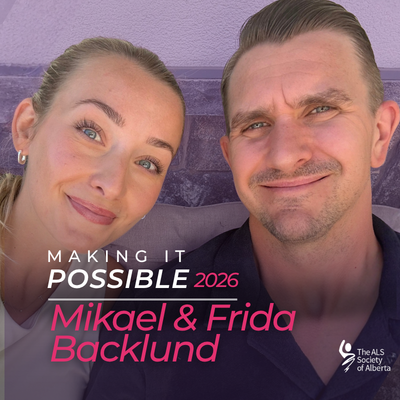
Making It Possible 2025 - The Backlunds, June 26

For nearly a decade, Mikael and Frida Backlund have been cornerstones of support for the ALS Society of Alberta. Their impact has grown year over year, with hundreds of thousands of dollars raised for ALS research, advocacy, and client support in Alberta. Their generosity and dedication continue to open doors for families across the province, and their unwavering commitment to the cause is nothing short of extraordinary.

The Backlunds’ support is rooted in something deeply personal: the memory of Frida’s mother, Ann, who lived with ALS. In her honour, the couple helped launch Achievements for Ann – The Backlund Fellowship in 2023, a groundbreaking initiative supporting ALS researchers in Alberta. Now in its second year, this fellowship continues to empower emerging scholars to accelerate progress in ALS and neuromuscular research.

Mikael, who has proudly served as the Captain of the Calgary Flames since 2023, and Frida bring heart and leadership to every aspect of their work with the ALS Society of Alberta. Their passion was on full display during the 2023 Uncorked for ALS event, hosted in memory of their dear friend Chris Snow, which raised an astounding $183,000 for ALS research in Alberta. The evening was living proof of the powerful community the Backlunds continue to inspire around them.

What makes Mikael and Frida’s support so impactful is that it goes beyond financial contributions. For many families living with ALS, the Backlunds offer the gift of togetherness and joy. Each year, they donate tickets to Calgary Flames home games, giving families the chance to enjoy a night out and create memories that are deeply cherished. To date, over 100 families have had the opportunity to attend a game, where Mikael always takes the time to meet and connect with each guest.

Currently, the Backlunds are supporting our cause through the Memories in Bloom sweater campaign. These sweaters are designed by Frida herself, in collaboration with Alberta Apparel, and are available online. 

Their kindness is authentic. Their dedication is lasting. Their impact is immeasurable.

The ALS Society of Alberta is deeply grateful to Mikael and Frida Backlund for their compassion, leadership, and the hope they bring to our community. Thank you for continuing to make it possible.

Making It Possible 2025 - Lesley Korman, June 25

When I was first diagnosed with ALS, I was completely defeated. I felt extremely depressed, isolated, and lost. I wanted to stay home. I didn't want to talk to anyone or be around anyone. This diagnosis stole all my dreams I had been working toward. Dreams my wife and I had been building over many years. We had big plans.

I worked more than full-time for many years as a medical laboratory technologist, and my wife worked just as much, all in the name of those big plans. Life was good. Really, really good, and it seemed to only be getting better.

Before ALS, I was very active and deeply engaged in the things I loved. Hiking, dancing, biking, traveling, playing video games, making jewelry, and playing guitar. But with ALS, everything became a race against time. A countdown to when I would no longer be able to do the things that once brought me so much joy.

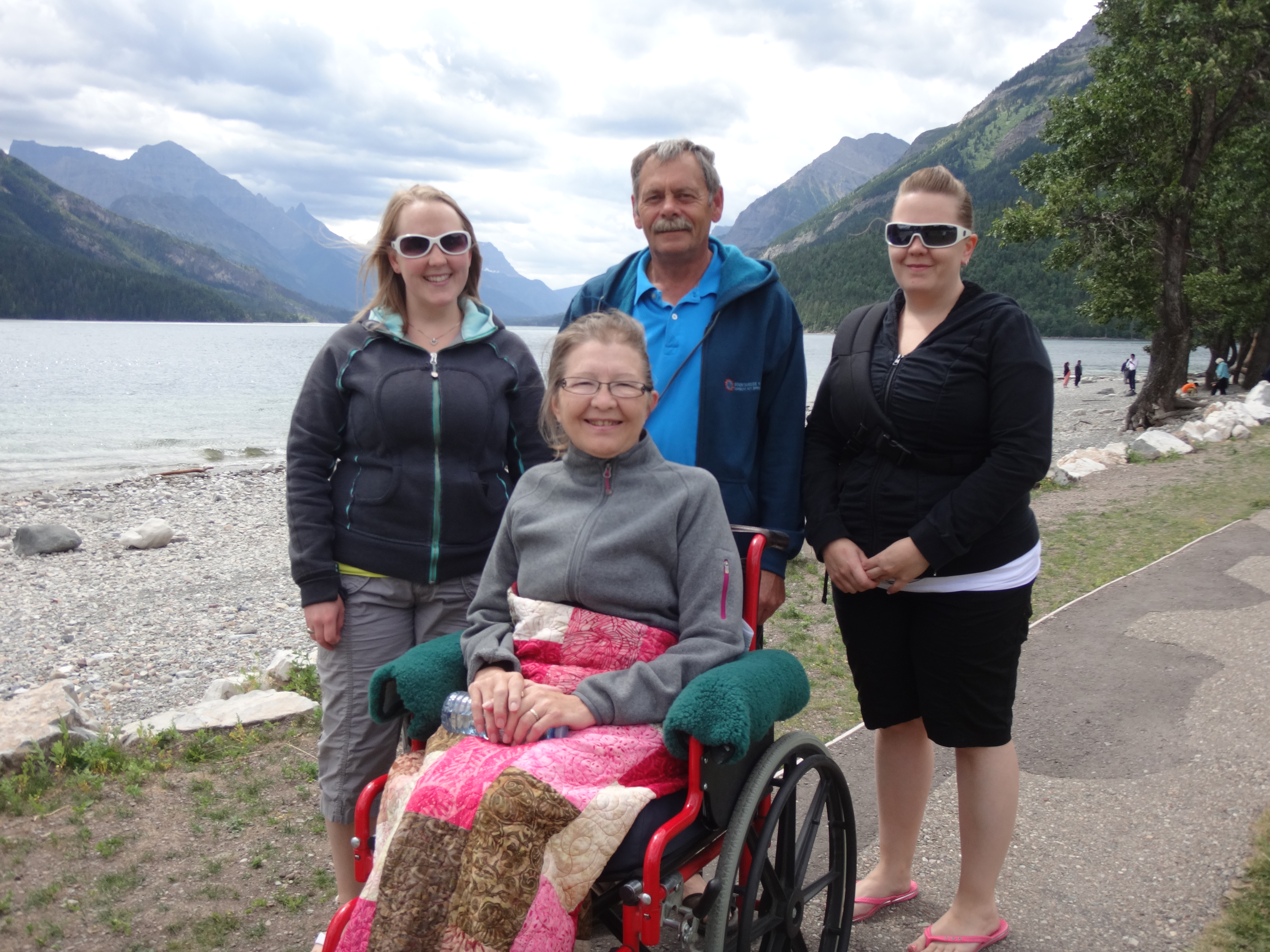
The ALS Society of Alberta helped make that time matter. Through their equipment loan program, I was able to borrow mobility supports that helped me stay independent and travel further than I ever thought possible. Because of that support, I’ve gone on an Alaskan cruise with my mom and my wife, taken multiple trips to Mexico with friends, toured wineries in Kelowna, visited Waterton National Park for the first time, and returned to my favourite places like Banff and the Shuswap, many times over the past year. 

And one of the biggest moments of all was being pushed up a mountain in a wheelchair by my wife and best friend to see the Grand Prismatic Spring viewpoint in Yellowstone National Park. A bucket list item I’ve dreamed of that has been missing a check for over  a decade!

None of it would have happened without my wife, Philomena, for whom I am deeply grateful. She has selflessly put her own life on pause to take care of me, both physically and mentally. Without her, I would have already given up.

I’m also grateful to my coworkers and friends, who were gentle and supportive in the long lead-up to my official diagnosis. They returned as Team Oh My Globulins! to Betty’s Run for ALS this year.

These days, I focus on meaningful moments. Going out for nice meals, playing video games, and most importantly, spending real quality time with my wife. I used to take that time for granted, thinking that family time was a thing reserved for weekends and vacation days, and maybe an hour or two after work. I assumed we’d always have it “later”. But ALS has taught me that later is never guaranteed. And that time with the people you love is the most valuable thing there is. 

I have no regrets about the life I lived before ALS. But I’m grateful that it taught me how so much beauty and connection can still exist, even now. Especially now.

Making It Possible 2025 - Rob Markley, June 24

My name is Rob Markley, and I have Bulbar-onset ALS. 

In February 2021, I visited my family doctor about occasional muscle cramping and twitching in my neck, lower face, and arms. He suggested magnesium for the cramping, but by early summer, the symptoms hadn’t improved. I had started slurring my words (and, no, this wasn’t from one too many beers). I was referred to a neurologist who ordered an MRI and Nerve Conduction Study. On September 14, 2021, I was diagnosed with ALS.

I was connected to the ALS Society of Alberta and the ALS Clinic at the South Health Campus in Calgary. Both have proven invaluable resources and provide a sense of community. The ALS Society of Alberta provided me with essential equipment, including a bidet, an adjustable hospital table, and neck braces that help with my day-to-day needs. More importantly, these organizations have helped us feel less alone.

After the initial shock of the diagnosis, I was left with more questions than answers. No one could tell me exactly what to expect, other than the hard truth that there is no cure, and that the average life expectancy is just 2-5 years. At first, my thoughts were consumed with how I would face my own pending death and how much of a burden I might become on my family. I still think about these things, but I now try to take life one day at a time.

Before the pandemic, I was very active, playing soccer and golfing a couple of times a week. When some of the restrictions were lifted, I considered returning to playing soccer. My lung capacity was still strong and I could still run. But after talking with my OT and PT specialists at the ALS Clinic, I realized the muscle loss in my arms put me at a high risk of injury. So, I gave up soccer. Then golf. Then driving. Then cooking. And so on, and so on. 

I’ve volunteered for every research study offered to me. I participated in two clinical research trials, both of which were unfortunately unsuccessful. My wife Maria and I even donated spit, blood, and poop samples for a microbiome study. As I like to say now, “a couple who collects poop together stays together.”

Maria is my caregiver. She prepares and cuts up my food, helps with personal hygiene, trims my beard and even clips my nails. I haven’t needed a feeding tube yet, but I know that day will come.

Still, we have so much to be thankful for. My ALS has progressed more slowly than many others. Fatigue is a daily reality, but I am still mobile and my breathing is still unaffected. We’ve been encouraged by our ALS community to resist giving in to the disease, and to keep doing what we can and love, for as long as we can, even if it’s difficult. 

In Spring 2022, we took a bucket list trip to Australia. That Fall, Maria officially retired and we sold our family home. We bought a new 2-bedroom condo with a large balcony so Maria can still enjoy planting her flowers, but does not have to shovel snow or mow the lawn. While waiting for our new home to be ready, we became nomads for 9 months, travelling and visiting loved ones often.

At this stage of our lives, we’re grateful. Grateful for our two amazing children, our wonderful grandson, and the most incredibly supportive and encouraging group of family and friends. Earlier this summer we participated in the 29th annual Betty’s Run for ALS. We’ve shared so many beautiful experiences and have many more to look forward to, including our daughter’s wedding this fall. Over the next few months, we’ll host visits from friends and family (I always tell our guests that Maria feeds me cat food, and I will never admit it isn’t true!), and take a few trips to the Okanagan and west coast. 

Our motto these days is simple: Just keep doing! ALS may take a lot from us, but Maria and I choose to meet each day with shared humour, love, and deep appreciation for all that we still have and all that is still possible

Alberta ALS Research Network Announces Research Trainee Awards

The Alberta ALS Research Network (AARN) is proud to announce its first funding awards. In collaboration with Mitacs, a Canadian NFP that has been investing in homegrown innovation for more than 25 years, these awards will help fund Alberta student and postdoc internships for research trainees focusing on ALS through Mitacs’ Accelerate program.

Growing opportunities for trainees and early career researchers is a primary target for AARN. Working with Mitacs helps meet that target while stretching AARN dollars further via Accelerate’s fund-matching model.

  • Graduate/Undergraduate Awards: AARN contributes $7,500 for a 4-6 month internship and Accelerate matches for a $15,000 research award (minimum $10,000 stipend, up to $5,000 toward research).

  • Postdoc Awards: AARN contributes $10,000 and Mitacs matches for a 4-6 month internship of $20,000 (minimum $15,000 stipend, up to $5,000 toward research).

  • Opportunities may exist to extend internships for repeated terms.

This is a time sensitive opportunity. If we wait too long to submit applications, the available funds will be gone. In the future AARN will have an established membership roll for award announcements. For now, we need your help getting the word out to potential interested parties at our universities.

Requirements are simple:

1. Research must be in the ALS field.
2. Researcher and PI must be in Alberta.
3. Applicant and PI must be AARN members. Become a member here.

Interested applicants should send an outline of their proposal to AARN for review (see below for full details).

Please direct any questions to AARN Project Manager Kelsie Snow at kelsie@alsab.ca.

About the Alberta ALS Research Network (AARN)

The Alberta ALS Research Network is a newly-launched initiative aimed at making Alberta a global leader in Amyotrophic Lateral Sclerosis (ALS) research and care. AARN’s mission is to accelerate research and find a cure for ALS by fostering collaboration between top ALS researchers at Alberta Universities.

Award Overview

The AARN Research Trainee Awards will support promising trainees to pursue innovative ALS research. Awards will be granted in partnership with Mitacs, a Canadian NFP organization that has been supporting research and innovation for more than 25 years, through Mitacs’ Accelerate program. Accelerate is a fund-matching program aimed at cultivating and encouraging Canadian student and post-doctoral researchers.

This award is open to Alberta-based undergraduate and graduate students and postdoctoral fellows working on ALS research under the supervision of an Alberta-based researcher.

Application Steps

1. Identify a supervisor at an Alberta-based institution whose research is relevant to the field of ALS.
2. Review the Accelerate application process and guidelines.
3. Submit an application outline to AARN, including:

  • Up to 1 page summary of the project

  • Up to 0.5 page summary of applicant qualifications

  • Up to 0.5 page describing the supervisor and training environment

4. Send your application outline to AARN.
5. Applicants selected by AARN will be invited to submit a full proposal to Accelerate via Mitacs’ online process alongside their supervisor and AARN.

Value

Selected undergraduate and graduate applicants will receive $15,000 per 4-6-month internship (minimum $10,000 stipend, up to $5,000 for research).

Selected postdoctoral applicants will receive $20,000 per 4-6-month internship (minimum $15,000 stipend, up to $5,000 for research).

Term

Internships run 4-6 months. Opportunities may exist to extend internships for repeated terms. Applicants interested in funding over multiple terms should indicate this in their application outline.

Eligibility Criteria

1. Applicant must be Alberta-based.
2. Supervisor must be Alberta-based.
3. Research must be relevant to the field of ALS.

Deadlines

Submit application outline by email to AARN Project Manager Kelsie Snow (kelsie@alsab.ca) by JULY 15, 2025.

Applicants selected for full Mitacs application will be notified by AUG 1, 2025.

Invited applicants must submit their full application to Mitacs no later than AUG 31, 2025.

Total number of awards will be determined based on AARN budget and quality of applications.

Review Process

Applications will be reviewed by AARN Steering Committee. Successful applicants will be invited to formally apply to Mitacs based on strength of application.

Please direct any questions to Kelsie Snow at kelsie@alsab.ca.

Making It Possible 2025 - Ralph Scott, June 23

It’s been nearly four years since I was diagnosed with ALS, and our life has been an emotional rollercoaster. We have felt frustration, hope, anger, and joy, all rolled into one. I’ve learned to give myself permission to feel it all and to hold space for my grief and sadness which are natural responses to the changes I am experiencing. Journaling, talking with friends, and connecting with Susan, my wife, have all helped me process those emotions. Remember, there's no "right" way to feel, and accepting that truth has brought me closer to accepting my ALS.

I’ve found strength and agency in focusing on what is still within my control. From adapting our home to suit my needs, to discovering new hobbies that bring me joy, and setting personal goals, these actionable steps help me feel empowered. I have advocated for myself in medical settings, explored assistive technologies, and created a daily routine that supports me and prioritizes my well-being.

My girls (our two dogs), and Susan help me stay grounded in the present moment and cultivate inner calm. For me, fostering a positive outlook doesn't mean ignoring difficulties. It means  finding moments of gratitude or joy to celebrate amid the challenges. These moments matter. Meaningful interactions like sharing a laugh with a loved one, admiring the beauty of a sunset, or maintaining close connections with loved ones are all vital. 

I’ve learned to communicate more openly with those around me. Being honest about my needs, feelings, and experiences has strengthened bonds and helps my loved ones understand how to best support me. At the same time, I am mindful of setting boundaries and taking time for self-care when needed.

Relationships are a source of immense strength, and nurturing them has enhanced my emotional well-being. With the support of the ALS Society of Alberta, I’m fortunate to have resources that have made this journey a little easier. And for that, I’m deeply grateful.

Making It Possible 2025 - Mike Olver, June 22

Growing up as a staff kid at Prairie Bible College, I lived for sports. Every day, if it bounced, rolled, or could be thrown, I was there. I might not have been the fastest kid on the diamond, but my body worked fine and I couldn’t have dreamed of a better childhood. 

Little did I know that there I would meet the love of my life in High School. The books didn’t stick, but one thing did: my love for Bev, leading to the best decision in my life, marrying her. Together, we built a life, raised two amazing kids, Theoren and Christina, and welcomed grandchildren who became our greatest joy.

I spent over 20 years at Prairie College, where they provided me with a wonderful opportunity to serve the community I loved (and perfect my golf game)! Life was full, and I was exactly where I wanted to be.  

Then, about 24 months ago, my body started sending me signals. Tingling. Twitching. A foot that refused to take a simple step. Test after test gave no answers, until hearing the doctor say three letters on March 13, 2024: “ALS”. They hung heavy in the air around me. Thinking to myself, “I’ve always been strong and active; how can this be?” It was a peculiar sense of relief to finally know, after so many months of not. The shock threatened to overwhelm us, and the silent drive home was almost unbearable as we wondered how we were going to tell our children who were anxiously awaiting news. 

ALS is relentless and unpredictable. It takes, little by little, and forces you to adapt. My left side is weaker than my right, but I’m still here, I’m still moving forward, and I still remind myself daily: I’m not dying from ALS; I’m living with ALS. And my life, even now, is filled with moments of kindness, love, and unexpected joy.  

In the summer of 2024, we took several wonderful trips to places like Oklahoma, Montana, and Ontario, not knowing so many would bless our socks off. We also travelled to Seattle, WA, to watch my Toronto Blue Jays play the Seattle Mariners, and what a memorable trip it was! As we’ve connected with extended family, dear friends, and fellow classmates, we have been rewarded over and over with incredible support and encouragement. 

Bev is my rock, my caregiver, my partner in all of this. Our children, our friends, and our community have lifted us in ways we never imagined. The ALS Society of Alberta has been an incredible support, helping us navigate this new reality with resources, equipment, and compassion. We don’t walk this path alone. 

As a young man, I valued strength and the ability to be active, never thinking that those days would come to such an end. Where do we turn when life leads us into a new season that we weren’t prepared for? With the help of my parents, I came to know Jesus as a young boy and have never regretted the decision to follow him. Why would we not count our blessings? Research into the disease holds promise, but there is no getting away from the fact that one day, sooner than we’d planned, I may very well be changing my address and meeting my Saviour face-to-face. In spite of the difficult path that lies ahead, however, I remind myself often how blessed I am.  

This is why I invite you to join me at Red Deer’s Walk Together for ALS on June 22, 2025 at Bower Ponds. Walk for those of us living with ALS. Walk for the families and loved ones behind us, walk for the caregivers beside us, and walk for a future ahead of us without ALS. Together, we will make a difference.

Making It Possible 2025 - Brian Dennis, June 21

When Monica was diagnosed with ALS, I was just as devastated as she was. I felt cheated. I felt like the life we had planned together was slipping away. And then it got worse. My wife has also been diagnosed with Frontotemporal Dementia, or FTD, alongside ALS. ALS changes everything, but when you’re living in it, you don’t always notice. Others noticed, but for us, it was about getting through one day at a time. 

You don’t realize how much stress you’re under until it sneaks up on you. It becomes part of your daily routine, and suddenly you're carrying a weight you didn’t even notice growing. My stress is different now. I sometimes catch myself wondering: “How long until she doesn’t remember me?”.

Caregiving affects everyone differently, just like ALS. It changes how you see things. Still, I don’t think I’d change anything, even if I had to do it all over again.

We are lucky, and grateful, for home care. Our main caregiver through AHS was so much more than just a support; they became dear friends. They have a genuine bond, and that makes a world of difference.

We know it is a downhill run, but our goal is to maintain her quality of life. The ALS Society of Alberta’s support groups became social events for us that we looked forward to. They are also a good excuse for me to bake and bring my blueberry lemon cake. There’s never any left over.

Monica is my priority. Every day, I get up early, have a couple cups of coffee, and go for a bike ride with my neighbor. That ride is something I do for me to stay well so I can be well for her. It is the one time I can step away from ALS. Every morning, my good friend always asks, “How’s Monica?” before shifting to other topics. I appreciate that so much. It might seem small, but it means a lot to talk about something else, even just for a little while. 

After my morning chores at home, I head out around 12:30 to spend the rest of the day with Monica. We hang out, walk around outside weather permitting, or participate in some of the many activities going on at the facility. In the evenings, we like watching hockey together in the TV room, even if we don’t always make it past 7:00 pm.

We made the tough decision to move Monica into long-term care three months ago, but when her physical needs outpaced what I could safely manage alone, we had to make that call. She is still there today, and thankfully, her care home is close by which helps ease that transition for both of us. 

Despite the many challenges, we make space for joy. We celebrated Monica’s 70th birthday at the restaurant where we got engaged many years ago. We turned it into a fundraiser for the ALS Society of Alberta, it was meaningful and beautiful. 

If there’s one message I could share with other ALS caregivers, it would be this: caregiving is really hard. But it’s also an act of deep love. It's the way we show up. Every day. Even on the hard ones.

Making It Possible 2025 - Adishwar Randhawa, June 20

Our father, Adishwar, whom many lovingly refer to as ‘Ronnie’, was diagnosed with ALS in January 2024. But the earliest signs of the disease made their first appearance in the spring of 2022, during a time when pandemic-related delays and restrictions made it all too easy to defer 

medical attention amid an overburdened healthcare system.

ALS has felt like a rude awakening not only for our Dad, but for our entire family. In many ways, ALS has stripped him of all the things he loved most. 

The first symptoms showed up on his daily 7KM walks. Staying active was staying sane for Ronnie. He walked daily, took pride in his health and body, nourished himself in all the right ways, and grimaced at the offer of any happy hour beverage. He was incredibly disciplined, so it was easy to pass off the first limb-onset symptoms as nothing more than a “bad knee”.

Today, Dad is surrounded by the love of his devoted and loving wife, his anchor and greatest source of strength and support, along with his three daughters, sons-in-law, and six grandchildren. Beyond his immediate family, he is deeply cherished by many whose lives have been touched by his generosity, compassion, and unwavering presence as a pillar of strength during their most trying times. 

Immigrating from Punjab, leaving behind his roots in 1980 to settle in Canada, Dad overcame countless challenges. Still, he would give the shirt off his back to help someone else, even if it meant hardship for himself. His warmth and sociability were just as defining. He continued making special trips to the bank just to connect and chat with tellers, long after most people had moved their lives online. 

As his daughters, some of our most cherished memories are those spent in our Kitimat living room. No TV. No phones. Just us laughing, sharing stories, soaking up the invaluable wisdom Dad so effortlessly imparted. With ALS, witnessing the gradual silencing of his voice has been heartbreaking, yet Dad continues to bring us all together. He unites us and ensures we still share our triumphs and struggles with him each week, despite his communication barriers. 

Dad’s spiritual faith has always been central. He carries Waheguru in his heart and lives by Chardi Kala, a state of unwavering optimism that defines his Sikh journey and continues to guide him through even the most difficult days. His devotion hasn’t wavered, and in turn, it inspires us to carry hope and hold faith in our own hearts, too. 

What we’ve come to understand is that while this ALS journey belongs to Dad, we, as a family, walk it with him. It is both an honour and a heartbreak. It is a reality that has transformed us in ways we never imagined. ALS reminds us that being human means holding grief and gratitude, sorrow and joy, anger, disappointment, and empathy - all at once.

Dad often says that ALS has taken the things he loved most: his ability to stay active, walk, write, sing, and speak. Each loss brings its own grief. But there is one thing ALS cannot touch, and that is the unconditional and immeasurable love we hold for him. 

That love is a reflection of what he’s given to us, over a lifetime. The compassion we show him today is the same care he’s extended to everyone around him so freely. The resilience we carry in his name mirrors the strength, courage, determination and dignity he’s embodied for as long as we’ve known him. 

ALS may have changed the way we move through the world, but it will never change the way we stand by his side with compassion and steadfast support. Just as Dad has carried us through every hardship, we will continue to carry and show up for him, every day, in every way.

Making It Possible 2025 - Conrad Gotzmann

I first noticed something was wrong when I was working on my car. I was tightening bolts when I realized I couldn’t let go of the wrench. My hand just wouldn’t open. 

I brushed it off, but about a year later, more symptoms showed up. I went to my family doctor and from there I was referred from one specialist to another, back to another doctor, until I finally found myself at the ALS Clinic. I was initially diagnosed with PLS  but after an EMG showed how my symptoms were progressing, my diagnosis was changed to ALS. 

It’s been difficult. Every moment, every breath, every step, is a reminder that I have ALS. 

This is why I say “I do the ALS Walk everyday”. 

It’s not just an event. It’s my life. I walk with ALS through every challenge, every adjustment, every small victory. But along the way I’ve learned something important: to truly receive, we have to be willing to give first. 

So I give by showing up. I wear my ALS Society of Alberta T-shirt proudly on my daily walks at the rec centre. It’s more than a shirt, it’s a signal. It’s an invitation to talk, to connect, and to raise awareness. 

When people ask, I share my story. Not because it’s easy, but because someone out there needs to hear it. 

I hope that by being open, I encourage others to give too. Whether they give of their time, their resources, or their compassion. 

Because ALS doesn’t just take. It teaches. 

It teaches you to value the steps you can still take. 

It teaches you to speak even when your voice trembles. 

It teaches you to give, so others can find hope in your strength.

This is my walk. And I’m still walking.

Making it Possible 2025 - Alan Widynowski, June 18

I spent over three decades working in Oil Exploration which took me all over the world. Early on in my career, I met Tatiya and have been married for 30 years now. After years of international travel and fieldwork, I eventually returned to Calgary to work locally. That’s when I began  noticing changes in my strength that made it difficult to do my job. 

It was in 2021 when the first signs appeared. I noticed cramping and weakness in my legs. I was an avid golfer, and I noticed that it was getting hard to walk up and down small knolls on the course. As time went on, stairs also became a challenge, and other everyday tasks like clipping my nails were frustrating. 

In May 2024, I was diagnosed with ALS and I was completely overwhelmed.

One of the first major decisions Tatiya and I had to make was whether or not to stay in our home or move. We chose to stay. That meant we had to make our home safer and more accessible.

My advice for anyone newly diagnosed is to get involved with the ALS Society of Alberta as early as you can. They’ll help you get the equipment you need to stay safe and independent. 

Since October 2024, they have loaned me a stair lift for my garage so I can get in and out of the house, as well as walkers that help me move around safely. They also supported us with rebates for other essential items like an EZ chair (powerlift recliner) and a personal bidet. 

Looking back, I remember one close call in particular, where I almost fell on the stairs. That was a turning point. It made me realize how important it is to make timely decisions, especially about equipment. They might be difficult, but they are necessary. Especially when it comes to staying safe and maintaining my dignity and independence. 

My advice is this: “Life doesn’t stop. Make the choices that keep you moving forward. Don’t hesitate.

Making It Possible 2025 - Bruce Beswick, June 17

My name is Bruce Beswick. I’m a retired military pilot and soldier. I served in the Canadian Air Force for 25 years, flying search and rescue missions in Buffalo aircraft before moving on to fly F-18 fighter jets out of Cold Lake. I also completed multiple tours in the Middle East, including a year in Afghanistan running an army camp with over 1,000 troops. I’ve seen a lot in my life; beautiful places, devastating moments, and experiences I carry with me to this day.

After returning home, I began noticing muscle twitches and a gradual loss in weight and strength. For nearly three years, I sought answers from doctors with no clear diagnosis. It wasn’t until April 2024, through the Operational Stress Injury Clinic in Calgary, that I was finally diagnosed with ALS.

At my physical peak, I was 245 pounds and could press 250! Today, I weigh 165 pounds and need help lifting a cup of coffee. I can no longer drive, and everyday tasks like brushing my teeth, doing up buttons, or walking to the kitchen are difficult or impossible without help.

But here's what hasn’t changed: my determination.

My life before ALS was full. I was raising a family, running a farm, and proudly serving my country. I’ve had the privilege of working overseas, including in Israel, Syria, Lebanon, Gaza, and Afghanistan. Through all of that, my wife was my rock. While I was deployed, she ran our farm with 50 head of cattle, 200 sheep, and two young kids, and she did this all flawlessly. She’s still my rock today.

ALS has forced me to slow down, but not to stop. My days begin and end with her help. While I can no longer hike or drive with my service dog, Shadow, I’ve found new ways to keep going: reading, faith, meaningful conversations, and finding joy in the quiet moments.

ALS has taken a lot from me physically. Here’s what I’m facing today:

  1. I’ve lost nearly 80 pounds of muscle.

  2. I need a chair to shower as I can’t stand for long.

  3. I can’t pull up my pants or do up buttons.

  4. Walking is limited to short distances.

  5. Brushing my teeth is difficult.

  6. I get tangled in blankets when rolling over.

  7. I can’t drive.

  8. I struggle to feed myself and I drink through a straw.

  9. I can’t lift my arms above my mid-chest.

  10. My hands shake. I can’t tie my shoes.

  11. I’ve lost my appetite.

Every one of these challenges requires help, and my wife is the one who helps me. She dresses me, prepares my food, and manages our daily routines. She is totally amazing. Her love and care grounds me. While I once found freedom behind the wheel taking backroad trips with my service dog Shadow, I now find peace in simply sitting beside her, holding hands as we drive. I can't say enough about how much she means to me. Her strength steadies me in every way.

A friend recently took me on a convoy drive through the mountains. We visited a remote site where a cross had been placed in memory of someone whose ashes had been scattered there. It was deeply moving. I took a photo and I hold onto it as a reminder of the beauty that still surrounds us.

The ALS Society of Alberta has also played a role, helping us access essential equipment that makes daily life more manageable. A real constant in my care journey has been my wife, and our incredible local church and friends who show up in ways both big and small.

Being a caregiver takes patience, grit, and heart. I see it in my wife every day. Accepting help hasn’t always been easy for me, but I’ve learned something important along the way. Gratitude matters. Say thank you. Mean it. Every day.

To anyone newly diagnosed: Make a promise to yourself to stay mentally strong, and stick to it.  Plan ahead. Accept help. Be grateful. And most importantly: Never quit. 

ALS might be part of your life, but it doesn’t define who you are. Never be afraid to share your story. You never know who it might help, or who might reach out and help you.

I don’t know what tomorrow will bring, but I do know how I want to meet it: with purpose, love, and perseverance. My goal is to ensure my wife is well cared for. And when I’m gone, I hope people remember me as a good man who tried to do right by others.

So here I am. Still pushing. Still grateful. Still refusing to give up.

Making It Possible 2025 - Stacy Hollister-Rank, June 16

My symptoms started in June 2023 with weakness in my left leg, nothing dramatic, just enough that I swapped my trademark stilettos for trainers. I chalked it up to getting older. After all, I was  57, and maybe it was time to retire the heels, especially when walking my dog! But by September, I knew something was very wrong. After reading thousands of articles online, I had a sinking feeling I already knew the answer. My diagnosis  was confirmed in July 2024: ALS.

The news was crushing. 

My initial reaction was fear, quickly followed by anger. And overwhelming concern for my husband and daughter. For months, I was consumed by the idea that was about to die. It felt impossible to see any kind of future. I never expected this to happen to me  and I  couldn't imagine how to go on.

I grew up and have always been independent. I’ve always been the one who fixed things, at work, at home, for everyone else. So the idea of asking for help seemed impossible. At the ALS Clinic, I was given a pack full of detailed information about ALS. I shoved it in a cupboard, hidden. Out of sight, out of mind, right? I wouldn’t, I couldn’t look at it. Every day felt like stepping into a minefield, and I didn’t know if I'd make it to tomorrow.

By Christmas, my mobility had worsened. I was falling more, but I still refused to consider using any kind of mobility aid. My daughter bought me walking canes. A friend gave me a walker. But I wanted to push through and keep things “normal” for as long as I could. 

Eventually, my daughter reached out to the ALS Society and started the conversation about getting me a stair lift, as she knew getting upstairs was becoming very challenging for me. At first, I was awkward,  and, I guess, stubborn and embarrassed. 

I didn’t want any help and I didn’t want to feel like a burden. I wanted everyone to  just leave me alone. But now? I’m over the moon that the stair lift is installed.

Once I accepted that I needed the help, I felt so much more confident being home alone. I cried for a few days, not because of the lift, but because of what it represents. And then, slowly, things began to shift.  The stairlift changed so many things for me. It gave me back a piece of my independence. It made me safer. It made life doable again.

And for that, I’m deeply grateful. To my daughter, and  to the ALS Society for pushing me and not giving up on me when I couldn’t yet accept help.

Looking back, we were in classic denial. I didn’t want to bother my friends.  I didn’t want to be a burden to my husband or daughter. I had cut myself off emotionally. 

But things started to change. 

We were gifted tickets to a Calgary Flames game by Mikael Backlund through the ALS Society of Alberta.  I never thought I’d have the motivation or confidence to attend, but it was fantastic. It gave me a lift I didn’t realize I needed. 

That experience opened the door to even more experiences. I started being more honest about what I need, both practically and emotionally.  I even let my husband take over vacuuming … which used to be one  of my favourite household chores!

I’ve also reconnected with old friends. The ones I’d avoided because I was worried they’re think I was only reaching out because of my diagnosis.  But, I’ve learned that reaching out doesn’t make you a burden on others. It makes you human. And those conversations have become one of the best parts in all of this. 

I’ve learned that I can be vulnerable. I can be loved. I can accept help - even if I can’t fully accept this disease.

Making It Possible 2025 - Cheryl Oshanek, June 15

I’m 63, and my ALS symptoms began in 2023. My gait and balance were suddenly out of whack to the point where I needed a cane. My husband was worried it might be a stroke as my symptoms came out of nowhere. We originally thought it could be related to a stomach infection, but even after surgery resolved that, the balance issues persisted. That’s when we knew something else was going on. 

I didn’t even realize I had a foot drop at the time. It was my eldest daughter (who had seen clonus in a loved one) who noticed the signs while helping me stretch. She urged me to bring it up with my physiotherapist. The moment I mentioned clonus, things moved fast. I was sent to the emergency department at Foothills Hospital, where an ER doctor saw the urgency and referred me to a neurologist. That was the start of a long process of testing: spinal taps, movement clinics, physiotherapy, and finally, an EMG. 

Almost exactly a year later, on June 28, 2024, I was officially diagnosed with ALS. 

If there’s one thing I’ve learned, it’s this: trust your gut. If something feels wrong, push for answers. If we hadn’t kept asking questions, who knows how long it would’ve taken for me to get a diagnosis? 

That year leading up to my diagnosis was tough. I resisted change, especially around my mobility. I used a cane, but I flat-out refused to switch to a walker, even when my family and doctors encouraged me. I was afraid that accepting more help meant admitting something was seriously wrong. 

It took falling and breaking my right arm (yes, I admit that this was not my smartest moment!) to finally understand how important mobility aids really are. 

Now, I can’t walk unaided. I use canes and walkers indoors, and a stairlift and bidet help with daily tasks. I can’t dress myself, and my left arm and hand are no longer functional. I’m currently on riluzole, gabapentin, and baclofen. Through it all, the ALS Society of Alberta and the South Health Campus clinic have been amazing in making this journey more manageable in truly practical ways. 

And even though ALS absolutely sucks, we’ve met some truly wonderful people. And yes, we still laugh, sometimes a lot, even about some of my limitations. 

Our youngest daughter came up with a brilliant idea, to create a family “corporate” structure where everyone has a job. It sounds funny, but it works: 

  • Daughter 1 and her husband, My Directors of Family handle all things family logistics, like dinners, coordination, and care by helping me with stretching and massages.
     

  • Daughter 2 is my Director of Fun. She planned a trip to Disneyland and organized a family trip to BC in June. We were going to be road tripping as a family as my husband was lucky enough to obtain a BraunAbility modified Grand Caravan from a family friends estate. Which gave me more freedom to get out and have fun by providing wheelchair via electric ramp. She also handles my shower and hygiene routines. 


Unfortunately we were unable to travel in June due to a health complication and I was hospitalized. As a Family we pivoted and pushed back the vacation and we will find other ways to enjoy each others company and celebrate the days and time we do have together regardless. My Grandson sent me a video to make me feel better and said “ALS is stupid Nana, I love you!”
 

  • My grandchild is my Director or comedic relief. He brings belly laughs daily, especially when he copies “Nana” walking with my cane and walker saying “I’m Nana” My daughter even got us a book to read together: Why My Grandma Is So Brave (a book about ALS for kids). It’s one of our favorites.
     

  • And my husband? My Darling Director of Danger Detection. Well, he has the hardest job of all, he’s on duty 24/7. He is responsible for home safety, navigating “danger zones,” and keeping everything running. His love and care are constant, and we all depend on him. 

Everyone takes their role seriously, and we laugh a lot about it, which keeps our spirits high. My Advice? Don’t forget to laugh. Life is still funny.  Don’t let ALS steal your smile.  Enjoy your family. Trust them. You can’t go wrong.